


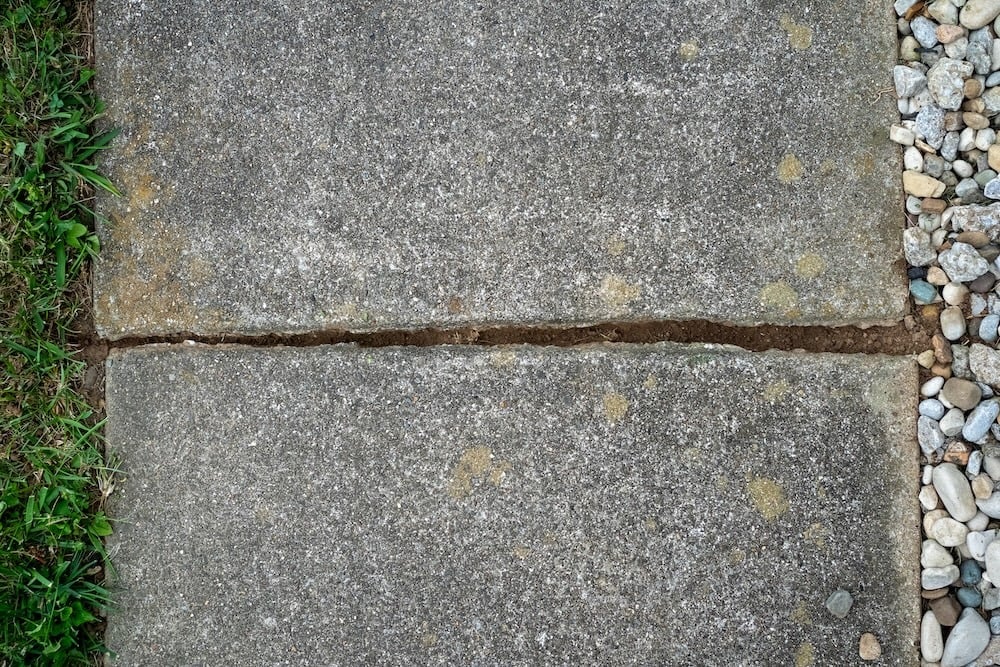
Those lines in your sidewalk don't all go the whole way through, and that's by design.
Growing up, plenty of us counted the lines in the sidewalk and tried not to step on them. Here's the twist: many of those lines are an illusion. Some are open gaps between slabs. Others are just a shallow groove cut into the surface.
Knowing which is which tells you what your concrete is doing, which joints need to be sealed, and when a crack means it's time to take action.
TL;DR
- Control joints are shallow grooves that give concrete a planned place to crack.
- Expansion joints are true gaps that let slabs move independently without pushing on each other or on your house’s foundation.
- All concrete cracks eventually, so the goal is to control where, then seal it with a flexible concrete-specific caulk.
- Rigid patches tend to pop off shifting slabs. Flexible caulk moves with the concrete.
In This Article
What Are the Two Types of Joints in a Concrete Sidewalk?
From standing height, sidewalk joints all look alike. Look closer, and they fall into two groups: control joints and expansion joints.
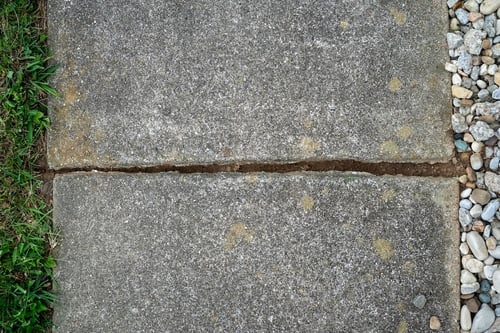
Example of a control joint between two sidewalk slabs that has cracked and widened over time. Notice the jagged edges where the crack was directed into the control joint.
Control Joints
Control joints are grooves that stop just below the surface. The groove is a deliberate weak point, so if the concrete cracks (and it probably will), the crack should follow the groove instead of wandering across the slab.
Think of how a chocolate bar snaps cleanly along its scored squares. The crack stays hidden in a straight line instead of showing up as a jagged crack across the surface.
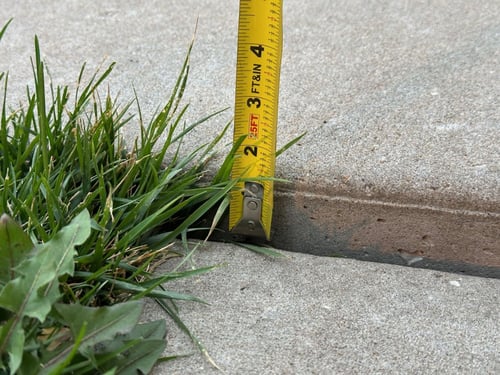
Example of an expansion joint running the full depth between two concrete slabs, allowing the slabs to move independently without cracking.
Expansion Joints
Expansion joints are the real gaps. They run all the way through the concrete and are usually filled with a material that flexes as the slab shifts. You'll find them between two sidewalk slabs, and where a slab meets another structure like a house or a deck column.
| Control Joint | Expansion Joint | |
|---|---|---|
| Depth | Partial depth (a groove) | Full depth (a gap) |
| Job | Steers where cracks form | Lets slabs expand and contract |
|
Where you'll find it |
Cut or tooled into the surface of a slab |
Between slabs, or between a slab and another structure |
|
Should you caulk it? |
Only once it has cracked (or if you prefer a uniform look) |
Yes, to keep water out |
Why Not Make Every Joint Go All the Way Through?
If concrete is going to crack anyway, why not pour each square as its own slab? It comes down to efficiency and longevity.
-
Efficiency: It's quicker to pour one long slab and plan for cracking with pre-formed grooves than to pour every square separately.
-
Longevity: Fewer full-depth gaps mean less exposure for the soil underneath. Concrete sinks when voids develop beneath the slab, and one of the biggest causes is water running underneath and eroding the supporting soil. Cutting every groove all the way through would give water many more ways in, which can lead to sinking.
- Upkeep: Any full-depth joint needs to be sealed with caulk to keep water out, and the cost adds up. By choosing control joints, a contractor gives the homeowner fewer joints to caulk, as long as those control joints stay uncracked.
Why Does Concrete Crack Anyway?
Concrete expands and contracts as temperatures change, and in colder climates, freeze-thaw cycles add even more stress. Expansion joints give slabs room to grow without building up tension against their neighbors. Without that room, the pressure has to go somewhere, and it can crack or lift the slab.
Control joints handle the rest. No matter how well it's poured, all concrete can crack. And when it does crack, the groove gives that crack a place to go. Once a crack forms, it should be caulked to help keep your concrete from sinking over time.
More Concrete Illusions
The lines aren't the only trick. That elaborate brickwork pattern in a modern walkway may not be brick at all. It's often stamped concrete, where builders press a large plastic or rubber stamp with a relief design into the wet concrete to give it a completely different look. It can even be made to look like wood. It's still concrete underneath, with the same joints and the same need for care.
Related Resource: 6 Types of Concrete Finishes – Concrete Finishing Techniques
Why Do Rigid Concrete Patches Fail?
Rigid concrete patches fail because the slab keeps moving. Between weak adhesion and constant shifting from freeze-thaw cycles, putting a rigid patch on a moving slab is like trying to fix a stretched rubber band with superglue. It just pops right off. We consider a rigid concrete patch a short-term fix for exactly this reason.
Expansion joints and cracks need a material that moves with the concrete. That's why we recommend flexible concrete caulk: it grows and shrinks naturally with the slab without tearing apart.
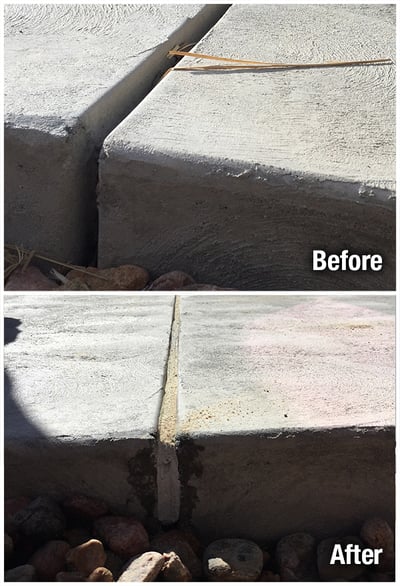
An example of an expansion joint between two slabs before and after being caulked with flexible concrete caulk.
What Should You Do About Cracked or Gapped Joints?
Now that you can tell your joints apart, here's how to treat them:
- Expansion joints: Keep them sealed with flexible caulk so water can't wash away the soil under your slab. Check them once or twice a year and reseal any spots that are pulling away.
-
Control joints: If they haven't cracked, they're doing their job and don't need caulk. If one has cracked, caulk it.
-
Uneven slabs: If one side of a crack sits higher than the other, consider concrete leveling to lift the slab so the repair sits on an even surface.
You can tackle small jobs yourself with our DIY crack-sealing guide. If you'd rather have a professional take a look, A-1 Concrete Leveling offers concrete caulking services at many nationwide locations. Request your free estimate today!
Frequently Asked Questions
Are the lines in a sidewalk cracks?
Not always. Many are control joints, shallow grooves cut or tooled into the surface on purpose. The full-depth gaps are expansion joints.
Do all sidewalk joints go all the way through the slab?
No. Expansion joints go all the way through. Control joints stop just below the surface.
Should I caulk the joints in my sidewalk?
Expansion joints should be sealed with a flexible concrete caulk. Control joints generally only need it once they've cracked. See our guide on caulking control and expansion joints for exceptions.
Can you prevent concrete from cracking?
Not entirely. All concrete eventually cracks. Joints control where it happens, and caulking cracks promptly helps keep them from expanding and helps protect the slab itself from settling.
Is concrete patch a permanent fix for cracks?
No. Rigid patch material doesn't flex with the slab and can pop off as the concrete shifts. A flexible caulk is a better match for joints and cracks.
Want more concrete myth-busting? Check out our educational videos on The Concrete Channel and other resources on Concrete Academy.
Request a Free Estimate
Find out how much safe, beautiful concrete will cost you with a free onsite estimate from an A-1 franchise near you.

